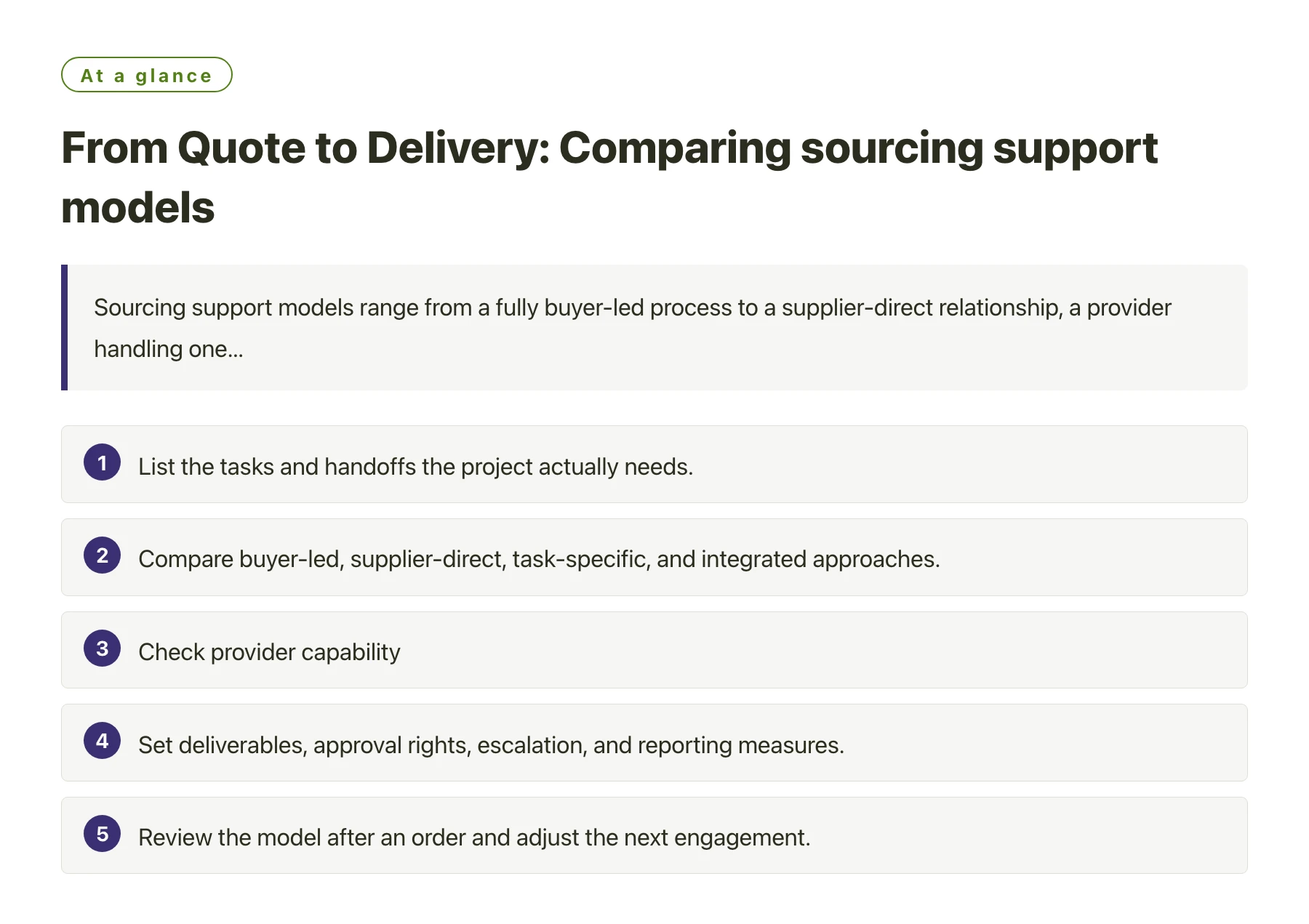
Sourcing support models range from a fully buyer-led process to a supplier-direct relationship, a provider handling one task, or an integrated coordinator covering several stages. Buyers should define the work, check incentives and capability, set approval gates, and retain clear ownership of product and compliance decisions.
Key takeaways
- List the tasks and handoffs the project actually needs.
- Compare buyer-led, supplier-direct, task-specific, and integrated approaches.
- Check provider capability, fee incentives, conflicts, and information controls.
- Set deliverables, approval rights, escalation, and reporting measures.
- Review the model after an order and adjust the next engagement.
A sourcing partner can fill a specific gap or coordinate a broader project. The right comparison starts with responsibilities and decision rights rather than a generic service label.
Define the work before choosing a model
Sourcing support can mean very different things: finding potential factories, checking business details, translating a technical brief, coordinating samples, negotiating commercial terms, monitoring production, arranging inspection, or supporting shipment handoffs. Before comparing models, list the work that is actually missing in your team and the decisions you need to retain internally.
Map the project from need definition through supplier selection, order execution, and supplier review. CIPS describes procurement as a cycle that can include market analysis, sourcing, negotiation, contracting, and supplier relationship management; a support arrangement may cover only selected stages.[1] Use that lifecycle to mark which tasks belong to your staff, supplier, independent service provider, broker, or specialist.
For each task, name the input, deliverable, owner, due date, and approval right. Examples include a screened supplier list, a comparable quotation matrix, a sample log, a production status record, or an inspection report. Avoid vague scope statements such as manage the project unless the activities, exclusions, and escalation route are clear.
Compare four practical support approaches
A buyer-led approach keeps supplier research, communication, and follow-up inside the company. It can work when staff have language coverage, time, product knowledge, and established supplier channels. The buyer controls records and relationships directly, but must budget for travel, response delays, technical review, and coordination across departments.
A supplier-direct approach lets the buyer contract and communicate with a factory without an intermediary. This can simplify accountability for product, price, and production commitments. It still requires the buyer to verify the counterpart, define specifications, manage changes, and use qualified inspectors or compliance advisers where needed.
A task-specific provider handles one bounded activity, such as translation, factory research, sample pickup, audit support, or an inspection visit. This is useful when the internal team can manage the overall order but needs local execution for a defined gap. Specify the evidence returned and who is authorized to make decisions; a provider completing a task should not be assumed to have release authority.
An integrated sourcing coordinator may combine supplier identification, commercial comparison, sample follow-up, order communication, and shipment coordination. This can reduce handoffs for a buyer managing several suppliers or product categories. The broader the mandate, the more important it is to define fees, conflicts, subcontracting, information access, deliverable standards, and the buyer’s approval gates.
Assess capability, incentives, and independence
Ask who performs each stage and whether work is subcontracted. Request examples of the documents or reports the team will deliver, who reviews them, and how corrections are handled. Confirm relevant product experience without treating a general claim of expertise as a substitute for a named reviewer and scope.
Understand how compensation works. A fixed fee, milestone fee, hourly arrangement, commission, or supplier-paid model can create different incentives. Ask who pays the provider, whether it earns from factories or logistics vendors, whether commissions are disclosed, and how recommendations are separated from commercial interests. Put the agreed fee basis and reimbursable costs into the contract.
Due diligence should cover the partner’s identity, capability, references, business terms, and role in the transaction. The U.S. Department of Commerce recommends evaluating prospective partners before concluding an agreement and describes company profiles and other research resources as possible inputs.[2] Match checks to the counterparty and risk; do not assume a directory listing proves legal status, factory ownership, or performance.
Protect drawings, customer data, branding, and product files. Agree on permitted use, storage, access, confidentiality, retention, and return or deletion at the end of an engagement. If the provider will communicate with suppliers on your behalf, approve message authority and require copies of material commitments and changes.
Set control points and measurable deliverables
Create approval gates for the supplier shortlist, final specification, quote selection, sample release, production start, inspection result, shipment booking, and payment milestones. State which decisions the service provider may prepare and which require the buyer’s written approval. This keeps useful coordination from turning into untracked commitments.
Define service measures that reflect the work: list completeness, response times, documentation accuracy, sample tracking, unresolved issues, or report delivery against a schedule. Avoid tying performance to outcomes the provider cannot control, such as customs clearance time or product compliance decisions owned by another party.
Agree on escalation for deviations. A quality issue, unexpected fee, factory substitution, late material, or booking change should reach a named buyer contact with evidence, options, and a deadline. Record the decision and revised timeline. Clarify whether the provider may recommend a remedy, negotiate a change, or only report facts.
Match the model to project complexity
A single repeat item with a qualified factory may need only direct communication and an independent final check. A new product, multiple suppliers, short launch window, or unfamiliar destination market may need more coordination, technical review, or specialized compliance advice. Consider internal workload and consequence of a missed handoff, not just the provider’s headline price.
For Shanghai JS Sourcing, buyers can evaluate a sourcing partner against the required service scope, supplier criteria, fee model, conflict disclosures, and reporting cadence. Request a written proposal that distinguishes included tasks from pass-through costs and exclusions. Retain final control over product acceptance, legal commitments, compliance judgments, and shipment release unless your contract explicitly assigns a qualified role.
Review the arrangement after a completed order. Compare promised outputs with delivered records, supplier response, issue resolution, and total cost. Use the review to narrow, expand, or replace tasks in the next project. A useful model fits the buyer’s governance and capability rather than applying the same service bundle to every purchase.
Sources
Frequently asked questions
Is an integrated sourcing provider always the best option?
No. It can reduce coordination handoffs, but a bounded task-specific provider or direct buyer-factory relationship may fit a simpler project and an experienced internal team.
What should a sourcing support proposal include?
It should name tasks, deliverables, schedule, exclusions, fee basis, pass-through costs, subcontractors, conflicts, approval gates, and escalation contacts.
Who should approve technical product acceptance?
The buyer’s designated qualified product or quality owner should make that decision unless a contract assigns it to an appropriately qualified party.
How can a buyer compare provider performance?
Review agreed outputs, timeliness, record accuracy, issue escalation, supplier communication, and total cost after the order, then revise the scope if needed.